Powerball Deep Analysis — Week of July 13, 2026 (Build Your Own Numbers)
Skip the homework?
The free app turns this exact analysis into five ready-made Powerball lines seconds after every draw.
This is our weekly deep-dive for Powerball — no ready-made picks here, just the raw analysis so you can build your own line. We break down the number pools, the play-slip pattern, the trend curve and the neighbor effect below.
Number pools — your raw materials
A solid starting recipe from the data: take two numbers from the hot pool, two from the middle pool, and one overdue swing pick — then sanity-check the line against the checklist at the end.
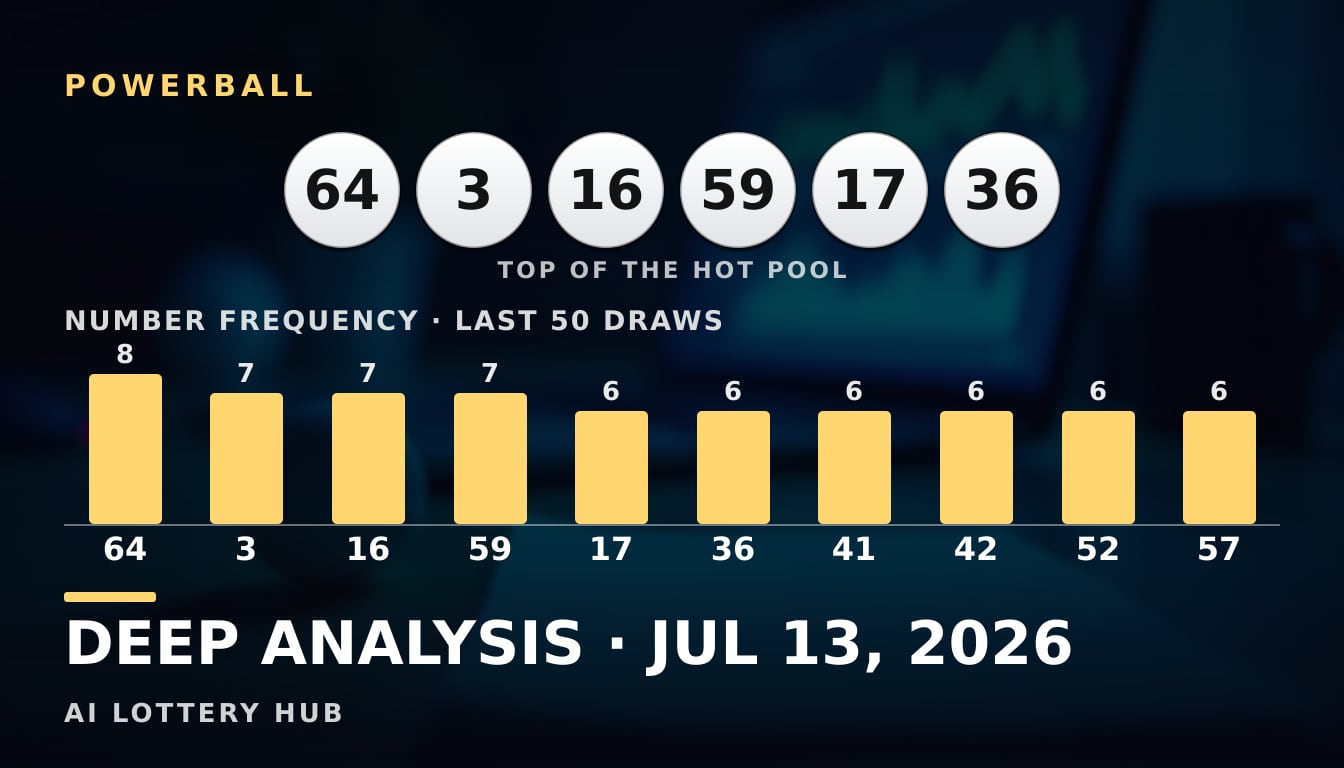
Hot pool — ride the streaks
The 8 most frequent numbers of the last 50 draws. Pick 2.
Middle pool — the quiet workhorses
8 mid-frequency numbers — neither hot nor cold. Pick 2.
Overdue pool — the swing picks
Longest absences right now (up to 50+ draws). Pick 1.
Play-slip pattern
Where winning numbers actually sit on the slip — by row (tens) and by ending digit. Lines that ignore whole regions of the slip fight the data.
Hits by slip row
Hits by ending digit
Sum trend — regression check
The total of each winning line, tracked over the last 20 draws. The trend is falling (slope -1.3 per draw, average 179). Aim your own line's total near the recent band of 154–211.
Momentum — risers & fallers
↑ Heating up
↓ Cooling off
Neighbor effect (adjacent numbers)
In 55% of the last 50 draws, at least one number landed right next to (±1) a number from the draw before it. The current neighbor candidates, built from the latest result:
Numbers one step away from the July 13, 2026 winning line.
Recurrence watch — rest streaks
A "recurrence" asks whether numbers from N draws ago come back. When that link goes quiet for a record-long stretch, folk-analysis calls it "due." The steps currently at or past their longest-ever rest:
Numbers those steps point to
Shared across the most overdue recurrences (the "duplicate" count).
Missing-interval map
Every number placed on the draw where it last appeared, by size position. Top rows are the longest-absent numbers; a blank means that slot's number already came back more recently.
| Draws ago | 1st | 2nd | 3rd | 4th | 5th |
|---|---|---|---|---|---|
| 45 ago | 11 | ||||
| 43 ago | 7 | ||||
| 37 ago | 9 | ||||
| 34 ago | 33 | ||||
| 30 ago | 18 | ||||
| 29 ago | 15 | ||||
| 27 ago | 22 | 56 | |||
| 25 ago | 65 | ||||
| 23 ago | 4 | ||||
| 21 ago | 51 | ||||
| 20 ago | 1 | 27 | 35 | 52 | |
| 19 ago | 42 | 47 | 58 | ||
| 17 ago | 32 | 64 | |||
| 16 ago | 24 | 34 | |||
| 15 ago | 31 | ||||
| 13 ago | 57 | 60 | 62 | ||
| 12 ago | 49 | 61 | |||
| 11 ago | 20 | ||||
| 10 ago | 19 | ||||
| 9 ago | 13 | 21 | |||
| 8 ago | 3 | 16 | 28 | 30 | |
| 7 ago | 41 | 53 | |||
| 6 ago | 2 | 6 | 26 | 39 | 68 |
| 5 ago | 38 | 46 | 50 | 69 | |
| 4 ago | 17 | 44 | 63 | 66 | 67 |
| 3 ago | 12 | 29 | 37 | 43 | 55 |
| 2 ago | 8 | 10 | 14 | 45 | 59 |
| 1 ago | 5 | 25 | 36 | 40 | 48 |
By gap band
Does the gap band matter?
| Band | Pool | Actual | Random | Lift |
|---|---|---|---|---|
| Out 10+ | 34 | 2.21 | 2.46 | ×0.90 |
| Out 7–9 | 7.6 | 0.51 | 0.55 | ×0.92 |
| Out 5–6 | 6.1 | 0.47 | 0.44 | ×1.07 |
| Out 4 | 3.5 | 0.35 | 0.25 | ×1.39 |
| Out 3 | 3.9 | 0.35 | 0.28 | ×1.26 |
| Out 2 | 4.3 | 0.38 | 0.31 | ×1.23 |
| Out 1 | 4.6 | 0.3 | 0.33 | ×0.90 |
| Out 0 (just hit) | 5 | 0.42 | 0.36 | ×1.15 |
Rolling check over 110 past draws. ×1.00 = no edge over random.
Sakai frequency bands
Numbers grouped by how many times they hit in the last 50 draws (6+ merged). The lift table asks whether "hot band" numbers really repeat more than chance.
Bands now
Lift by band
| Band | Pool | Actual | Random | Lift |
|---|---|---|---|---|
| 6+ hits | 10.3 | 0.84 | 0.74 | ×1.12 |
| 5 hits | 9.5 | 0.58 | 0.69 | ×0.85 |
| 4 hits | 13 | 1.03 | 0.94 | ×1.09 |
| 3 hits | 15.9 | 1 | 1.15 | ×0.87 |
| 2 hits | 11.6 | 0.93 | 0.84 | ×1.10 |
| 1 hit | 7.2 | 0.49 | 0.52 | ×0.94 |
| 0 hits | 1.9 | 0.16 | 0.14 | ×1.17 |
Numbers that hit N times, checked against the next draw.
Reality check — does any signal beat random?
We took each strategy's number pool and, for every one of the last 110 draws, counted how many actually hit — versus what pure chance predicts. The honest result:
| Band | Pool | Actual | Random | Lift |
|---|---|---|---|---|
| Hot pool | 8 | 0.62 | 0.58 | ×1.07 |
| Overdue pool | 8 | 0.59 | 0.58 | ×1.02 |
| Cold pool | 8 | 0.55 | 0.58 | ×0.94 |
Actual hits per draw vs random expectation. Everything hovers near ×1.00 — no signal reliably beats chance. We publish the check instead of hiding it.
Payout strategy — dodge the crowd
This is the one edge that's mathematically real — not on your odds, but on your payout. A Powerball jackpot is split among all winners, and most players pack their lines with calendar dates (birthdays, 1–31). Only 45% of the 69-number pool sits at or below 31; the 38 numbers above it get chosen far less often.
Less-crowded pool · 32–69
Leaning a couple of picks into this range doesn't change your chance of winning — but if you do win, you're less likely to share the prize. Never spend more chasing it.
Line Lab — stress-test your own numbers
Type a Powerball line (or roll a random one) and we grade it two ways: how it would have scored across the last 50 draws, and how well it fits the patterns above. All in your browser.
Backtest is for entertainment only. Every combination has identical odds — matching past draws never changes that.
Final checklist before you play your line
- Balance: shape your line toward 3 odd / 2 even — the most common split (34% of recent draws).
- Spread: cover at least 3 different slip rows; 46% of draws lean 2 low / 3 high.
- Total: keep the sum inside 154–211.
- Consecutive pairs: one pair is fine (20% of draws have one); avoid three-in-a-row.
- Carry-over: 37% of draws repeat a number from the previous drawing — including one is a data-backed choice.
Reminder: every combination has identical odds. These rules match the shape of typical winning lines — they can't beat randomness.
Everything above updates weekly as draws come in. Build your line, check it twice — or let the app's AI do the assembling while you just play.
Rather have it assembled for you?
AI Lottery Hub posts fresh predictions seconds after every New York drawing. Carry them in your pocket.
